Invisible Killer in High Temperatures-Heat Stress in Chickens Ⅳ
Oxidative Stress and Antioxidant Defense System
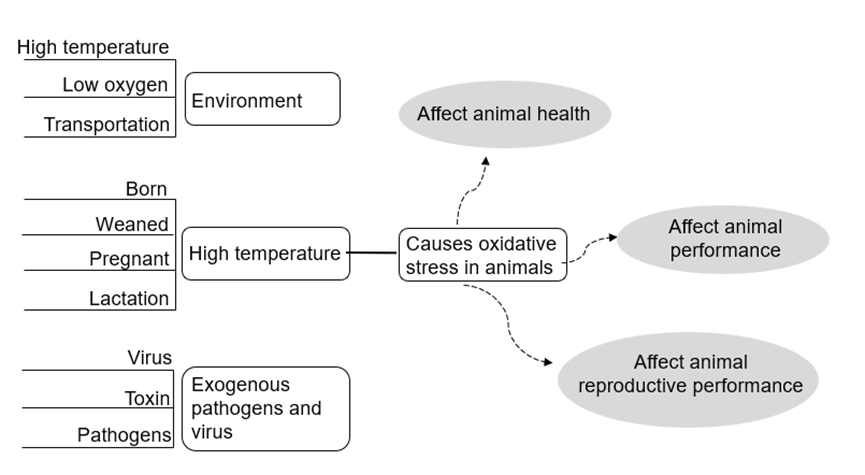
Concept of Oxidative Stress
Oxidative stress refers to the imbalance of oxidation and reduction homeostasis in the body, which makes the body more inclined to oxidation, resulting in excessive production of oxygen free radicals/reactive oxygen species (ROS) in the body and causing body damage (SIES, 1997).
Oxidative stress (OS) causes damage to cell and tissue structure, seriously harms the liver and other organs, inhibits the production of various hematopoietic stem cells and red blood cells, reduces the body's immunity, causes immunosuppression, and affects the health and production performance of animals. At the same time, oxygen free radicals are also the main cause of body aging.
A class of small molecules that are continuously produced in the mitochondria of the liver during metabolism are called reactive oxygen species (ROS). When the body is in a normal physiological state, the production and clearance of ROS are dynamically balanced. Under normal physiological conditions, ROS can stimulate the activity of antioxidant enzymes and increase the antioxidant capacity of the body. When the body is subjected to various internal and external stimuli, the oxidation system and antioxidant system of the body are unbalanced, and the ROS production rate in the body exceeds the clearance rate of the antioxidant system, resulting in a large accumulation of ROS. Excessive ROS will attack some important biological macromolecules, such as nucleic acids, proteins and lipids, which can cause lipid peroxidation, protein oxidation and inhibition of oxidase activity, so that cell homeostasis is damaged, and serious cell death can be caused.
In animal production, feeding environment, feeding density, weaning, transportation and mycotoxins in feed raw materials will induce excessive production of reactive oxygen species (ROS) in animals, causing oxidative stress. Eventually, it leads to the emergence of related chronic diseases and the decline of animal production performance, affecting the quality of animal products.
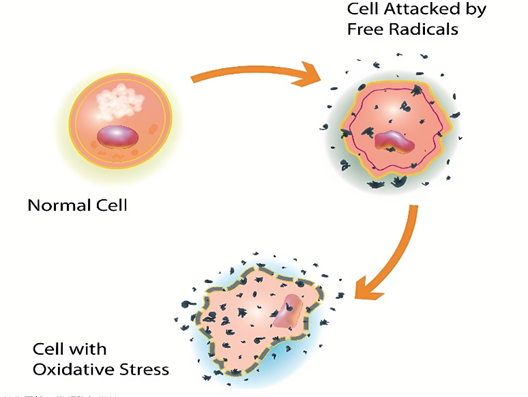
Free radicals act on normal cells
1. Mechanism of oxidative stress (OS) on body damage
Three common types of free radicals: superoxides, hydroxides and peroxides.
There are many factors from the external environment that promote the increase of free radicals in animals: such as various urgent reactions, endotoxins, mycotoxins, pathogens, climate and environmental changes, diet changes, anti-nutritional factors in feed, inflammatory reactions, etc. When the above factors occur, the mechanism of the animal system to produce antioxidants is easily unbalanced, and a large number of free radicals accumulate in the body, causing different health problems, and the risk of infection of various germs will also increase.
Oxidative stress (OS) causes macrophages to produce a large number of oxidative intermediates, such as ROS (reactive oxygen species) and RNS (reactive nitrogen). Both are typical pro-inflammatory mediators, and a large number of ROS and RNS can be used to defend against pathogens during inflammation. The inflammatory process is the physiological response of the immune system to injury stimuli from various sources. Its purpose is to restore homeostasis and maintain a constant internal environment.
When an inflammatory response occurs, the body's antioxidant action is activated to clean up the peroxides and cytokines produced by the inflammatory response. If the antioxidant capacity of the body is reduced, the antioxidant effect can not keep up with the damage speed caused by the inflammatory response, which aggravates chronic inflammation, and eventually causes more cell death and tissue damage, resulting in intestinal mucosal damage, loss of immune response, and disease.
2. Antioxidant system
The antioxidant system in vivo includes both various antioxidant enzymes and various antioxidants with antioxidant function.
The antioxidant enzymes in the body include superoxide dismutase (SOD), catalase (CAT) and so on. These antioxidant enzymes form the body's first line of defense against oxidative stress (SURAI et al., 2019). When ROS production increases in the body, the activity of antioxidant enzymes also increases, breaking down ROS in large quantities and protecting the body from oxidative damage.
Exogenous organic antioxidants: polysaccharides (yeast derived beta-glucan, chitosan oligosaccharides), selenium yeast, vitamins (vitamin E and vitamin C), natural pigments (beta-carotene, lycopene, astaxanthin), glutathione (GSH), polyphenols (tea polyphenols), sterols.
Exogenous inorganic antioxidants: ammonium sulfate, sodium sulfite, sodium nitrite, etc.
3. Gut Agility
The growth performance of animals is related to their response to stressful factors. Recently, some scholars proposed a new nutritional concept of intestinal stress resistance - Gut agility.
The main function of the gastrointestinal tract of animals is to absorb nutrients and prevent pathogens and toxins from entering the blood barrier. Good gut agility can improve the ability of animals to cope with stress factors, reduce the loss of energy to adapt to urgent factors, optimize growth performance and feed efficiency.
Oxidative stress leads to damage of intestinal integrity, inflammation, and even changes of flora, etc. These physiological reactions not only affect the growth performance, but also cause the loss of production cost due to energy loss.
Intestinal cells with good antioxidant power are tightly linked to each other, which can reduce the movement of disease sources and toxins between intestinal cells in the first line, and strong cells are less affected by inflammation, reducing energy loss caused by the production of free radicals, so that even in the condition of environmental changes or contaminated feed, they can adapt to the urgent and show the best growth performance.
Factors that trigger heat stress in chickens
There are many factors that cause heat stress in chickens, which are mainly affected by environmental temperature, humidity and physiological changes of the animals themselves.
1. With the increase of global average temperature, the frequency of summer high temperature extreme weather is increasing, and the change of ambient temperature greatly increases the probability of heat stress.
2. Although the intensive production mode saves land and production costs, it also brings the problem of excessive density of chickens. When the ambient temperature rises suddenly or the heat production of poultry surges, the ventilation equipment cannot discharge the heat in the chicken house in time, which is easy to cause heat stress of chickens.
3. The physiological characteristics of chicken also make it easy to produce heat stress: chicken has no sweat glands and is covered by feathers, so it can only expel heat generated by body metabolism through respiratory evaporation and heat dissipation.
4. In addition to temperature, humidity and amount of exercise also affect the occurrence of heat stress.
5. The occurrence of heat stress is also affected by genetic factors. Compared with local breeds, the most commercially available white feather broilers are more sensitive to changes in environmental temperature and more prone to heat stress due to their fast growth rate, high metabolic rate and poor heat resistance.
For different kinds of chickens, due to the differences in breed, age, body condition and so on, as well as the difference in the time and intensity of heat stress, the impact of high temperature on different breeds of chickens is also different. When in the appropriate thermoneutral zone, chickens can maintain a relatively constant body temperature through the physiological behavior of regulating metabolism. The range of isothermal/thermally neutral zones also changes with the age of chickens. For example, the optimum temperature range of 1-week-old broilers decreases from 28-32℃ to 19-25℃ and the relative humidity is 50-60% compared with 6-week-old broilers (Borges et al., 2003).
Mechanism of heat stress affecting chicken performance
Heat stress has seriously affected the development and economic benefits of chicken industry. A large number of literatures have shown that heat stress can reduce feed intake, inhibit growth, development and reproductive performance of chickens. The structure of chicken intestinal flora is disturbed and the body immunity is reduced.
Damage the normal physiological function of liver, reduce antioxidant capacity, lead to metabolic disorders; The muscle quality of broilers decreased, laying rate decreased and egg weight decreased. In severe cases it can lead to death.
Studies have shown that compared with broilers reared at 24-27℃, feed intake and feed conversion rate of broilers reared at 30-35℃ decreased by 10.18% and 9.74%, and there were significant differences in body weight and average daily gain (Wang Shichang et al., 2007). The average daily gain and average daily feed intake of yellow-feathered broilers raised under high temperature conditions were significantly lower than those in the normal temperature group, and the ratio of feed to gain was significantly higher than that in the normal temperature group (Zhong Guang et al., 2018). Some experiments showed that the harmful effects of chronic heat stress on the production of laying hens increased with the increase of age, and the laying rates of laying hens exposed to heat stress at 8-14d, 30-42d and 43-56d decreased by 13.2%, 26.4% and 57%, respectively (Farnell etal., 2001). In another study, laying hens experienced significant decreases in egg production, body weight, and feed intake after 5 weeks of heat stress treatment (Mashal yet al., 2004).
1. Heat stress significantly affected chicken feed intake
Chickens eat to satisfy their energy needs, but also to produce feelings of fullness. Under normal conditions, metabolic energy increases and feed intake decreases. By reducing feed nutrient concentrations under thermoneutral zone conditions, chickens are able to ensure adequate nutrient intake by increasing feed intake. There is little research on this subject
The hypothalamus is the main integration center of various appetite regulation signals, and its most important appetite regulation site is the arcuate nucleus (ARC), which contains two opposite neuronal branches, one neuron is the neuron that promotes food intake, called NPY/AgRP, and the other neuron is the anorexic neuron, called POMC/CART, responsible for suppressing appetite (Yuet al., 2009). The gastrointestinal tract is the main organ of digestion and absorption of nutrients in poultry. Gastrointestinal epithelial cells can feel food stimulation, thereby regulating the release of peripheral appetite factors, which in turn regulate the contraction or peristalsis of gastrointestinal smooth muscle, gastric empting, and play an exciting or inhibitory role in the secretion of gastric acid. In addition, peripheral appetite regulators can transmit appetite signals (fullness or hunger) to the center through the vagus nerve (Cote etal., 2014).
Studies have shown that high temperature conditions can inhibit the excitability of hypothalamic feeding center, and significantly increase the plasma, intestinal cholecystokinin (CCK) and ghrelin concentrations in chicken gastrointestinal tract. Cholecystokinin (CCK) and ghrelin are both hormones that inhibit feeding in chickens (KAIYA et al., 2013), so heat stress significantly reduces feed intake and production performance of chickens. It is generally believed that the thermal neutral zone range of chickens is 21-28℃, and the optimal production performance is achieved at the ambient temperature of 21-28℃.
As can be seen from table, with the increase of ambient temperature, the overall production performance of yellow-feathered broilers gradually decreases. There were no significant differences in daily gain, feed intake and ratio of feed consumption to gain among groups 20 and 25, 28 and 30 (P>0.05). Compared with the 30 group, all indexes of production performance in the 20 group were better (P<0.05), and the ratio of feed to gain and mortality in the 25 group were significantly decreased (P<0.05).
It was reported that chronic heat stress resulted in a 16.4% decrease in feed intake, a 32.6% decrease in body weight and a 25.6% increase in feed/meat ratio of 42-day-old AA broilers compared with normal temperature group. Mei Liu et al. reported that acute heat stress significantly reduced the average feed intake and average daily gain of AA broilers aged 20-34 days, and significantly increased the feed to meat ratio. In addition, it has been reported that when the feed intake is the same, the protein deposition of heat-stressed broilers is significantly reduced, and the subcutaneous fat content is significantly increased, and the increase of subcutaneous fat content will affect the skin heat dissipation of broilers, leading to a vicious cycle.
For laying hens, the ambient temperature also has a great influence on feed intake and laying rate. Studies have shown that when the ambient temperature is within the thermal neutral zone of chickens, the feed intake decreases by 1% for every 1℃ increase in temperature. When the ambient temperature exceeds the thermal neutral zone, at 32 ° C ~38 ° C, the feed intake decreases by 4.6% for every 1 ° C increase. Under the influence of heat stress, feed intake of laying hens decreases and metabolism accelerates, which seriously affects the absorption and utilization of nutrients by laying hens, resulting in a significant decrease in laying rate, eggshell strength, eggshell thickness, protein height and Haugh unit.
2. Effects of heat stress on chicken behavior
There are no sweat glands on the surface of the chicken body, and there are rich feathers covered in the body, when the outside temperature is high, chickens often like to stay in the shade to rest, reduce activities; Because the body needs to increase heat dissipation to protect itself, it will cause the hair on the body surface to disperse and appear the phenomenon of "pecking", and it will also cause underdeveloped feathers and hairless phenomenon on both sides, making the "secondary chicken rate" significantly increased. At this time, it is often accompanied by a decrease in feed intake and a large number of frequent drinking phenomena, which makes the excretion of feces wet. In severe cases, "feed feces" will be discharged (Zhao Jinbo, 2016). The heat dissipation can be increased by extending the neck and opening the mouth for breathing to speed up the respiratory rate. If the living environment temperature is too high, the chicken will frequently open its two beaks to make it in a state of rapid breathing, and will show thermal wheezing for a long time, and the chicken's thorax will show obvious expansion and contraction during production. The flesh beard, comb and eye conjunctiva of chickens are all visible purplish-blue to the naked eye (Liang Guiling, 2018).
Original Source: Huimu Power
|


 Article Sharing | Interactions Between the Porcine Host and Gut Microbiota — The impact of gut microbiota on the host immune system Ⅱ
 Article Shareing | Interactions Between the Porcine Host and Gut Microbiota — The impact of gut microbiota on the host immune system
 Article Sharing | Interactions Between the Porcine Host and Gut Microbiota — The Role of Antibiotics
 HUADE VOICE| The Festive Spirit Lingers — Life at Huade


