|
What Happens in the Case of Infection? Studies have found that when animals are infected or attacked by pathogenic microorganism, the corresponding secretion of antimicrobial peptides in the body will increase sharply (100-1000 times) to fight inflammation. Chicken β-Defensin Gallinacin-6 (Gal-6), is expressed in the chicken digestive tract and has antimicrobial activity against food-borne pathogens (3). The secretion of poultry defensin usually begins to express around 13 days in natural environments. Gal-6 was strongly and equally expressed in adult Ross 308 chickens and 3-week-old Hybro chicken broilers.Yet, in crop tissues from 2-week-old Ross 308 chicken broilers,levels of Gal-6 mRNA were low or not detectable in seven of the nine animals investigated(3). (FIG.1) Figure 1. Gal-6 mRNA expression levels in chickens of different ages and breeds (3) (cDNA fragments of β-actin were amplifified (33 cycles) with the same RNA samples as a control)
There are a total of 14 known chicken AMPs to date that are referred to as Avian β- When poultry are infected with Salmonella, expression of AvBDs in different breeds will increase diversely. It can be seen that the challenged Fayoumi birds have more expression of AvBDs versus their counterparts and that across the three lines the challenged birds express more AvBDs than non-challenged birds.(7) (FIG.2) Figure 2 Avian β- defensins Expression(7)
Porcine beta-defensin 1 (pBD-1) is expressed throughout the epithelia of the tongue, the respiratory and gastrointestinal tracts, and a variety of other
From this study we can see that expression of pBD-1 was found only in the tongue of newborn piglets but in all investigated tissues of 4-5-week-old piglets, which means newborn animals were fully susceptible to the disease(1) (FIG.3)
When swine are infected by Salmonella, defensins’ secretion changes dramatically. From this study we can see that A and B shows that a 1000-fold increase in production of pBD-2 and a 100-fold increase in pBD1 is observed. (2) (FIG 4). Figure 4. Baseline gene expression of pBD-1 and pBD-2 (2)
When aquatic animals are infected by pathogenic microorganisms, the expression of AMPs will also increase dramatically. Perch
This is the expression of Hepcidin of Perch after the injection of m.luteus and Escherichia coli. Hepcidin is a kind of antimicrobial peptide from liver of fish. A 4500-fold increase in hepcidin expression was seen in the liver of challenged fish (Table 1) (4)
Scallop This is Expression of Defensin of Argopecten irradians (AiBD) in Vibrio anguillarum. Fig 4. Temporal expression of the AiBD (beta-defensin of Argopecten irradians)
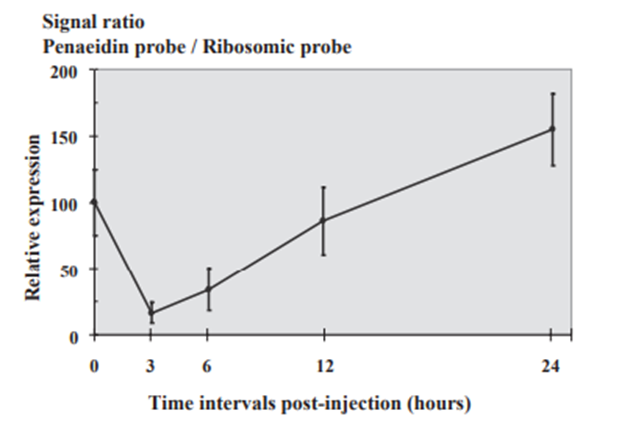
Shrimp This is the Expression of Penaeidins of Penaeus vannamei after the injection of composite bacteria dead cell. Penaeidins are members of a new family of AMPs isolated from a crustacean, which present both gram-positive antibacterial and antifungal activities. An increase in plasma penaeidin concentration occurs after microbial challenge. (6)
1. Shokrollah Elahi, Rachelle M. Buchanan, Sam Attah-Poku, etc.(2006). The Host Defense Peptide Beta-Defensin 1 Confers Protection against Bordetella pertussis in Newborn Piglets. INFECTION AND IMMUNITY, Apr. 2006, p. 2338–2352. 10.1128/IAI.74.4.2338–2352.2006 2. Edwin J.A. Veldhuizen et al.,. Differential regulation of porcine b-defensins 1 and 2 upon Salmonella infection in the intestinal epithelial cell line IPI-2I. 3. Albert van Dijk, Edwin J. A. Veldhuizen, Stefanie I. C. Kalkhove, (2006). The _-Defensin Gallinacin-6 Is Expressed in the Chicken Digestive Tract and Has Antimicrobial Activity against Food-Borne Pathogens. ANTIMICROBIAL AGENTS AND CHEMOTHERAPY, Mar. 2007, p. 912–922. doi:10.1128/AAC.00568-06 4. Hiroko Shike 1, Xavier Lauth, Mark E Westerman.(2002). Bass hepcidin is a novel antimicrobial peptide induced by bacterial challenge. DOI: 10.1046/j.1432-1033.2002.02881.x 5. Jianmin Zhao, Linsheng Song, et al. Molecular cloning, expression of a big defensin gene from bay scallop Argopecten irradians and the antimicrobial activity of its recombinant protein. Molecular Immunology, 2007, 44: 360-368. 6. Delphine Destoumieux, Marcello Muñoz, Céline Cossea, etc. (2000). Penaeidins, antimicrobial peptides with chitin-binding activity, are produced and stored in shrimp granulocytes and released after microbial challenge. Journal of Cell Science 113, 461-469 7. G. E. Nodell,M. G. Kaiser, and S. J. Lamont,Antimicrobial Peptides Avian β-defensin and Cathelicidin Expression in Salmonella enterica Challenged Poultry Spleens,Department of Animal Science, Lowa State University.
|
 Article Sharing | Interactions Between the Porcine Host and Gut Microbiota — The impact of gut microbiota on the host immune system Ⅱ
 Article Shareing | Interactions Between the Porcine Host and Gut Microbiota — The impact of gut microbiota on the host immune system
 Article Sharing | Interactions Between the Porcine Host and Gut Microbiota — The Role of Antibiotics
 HUADE VOICE| The Festive Spirit Lingers — Life at Huade